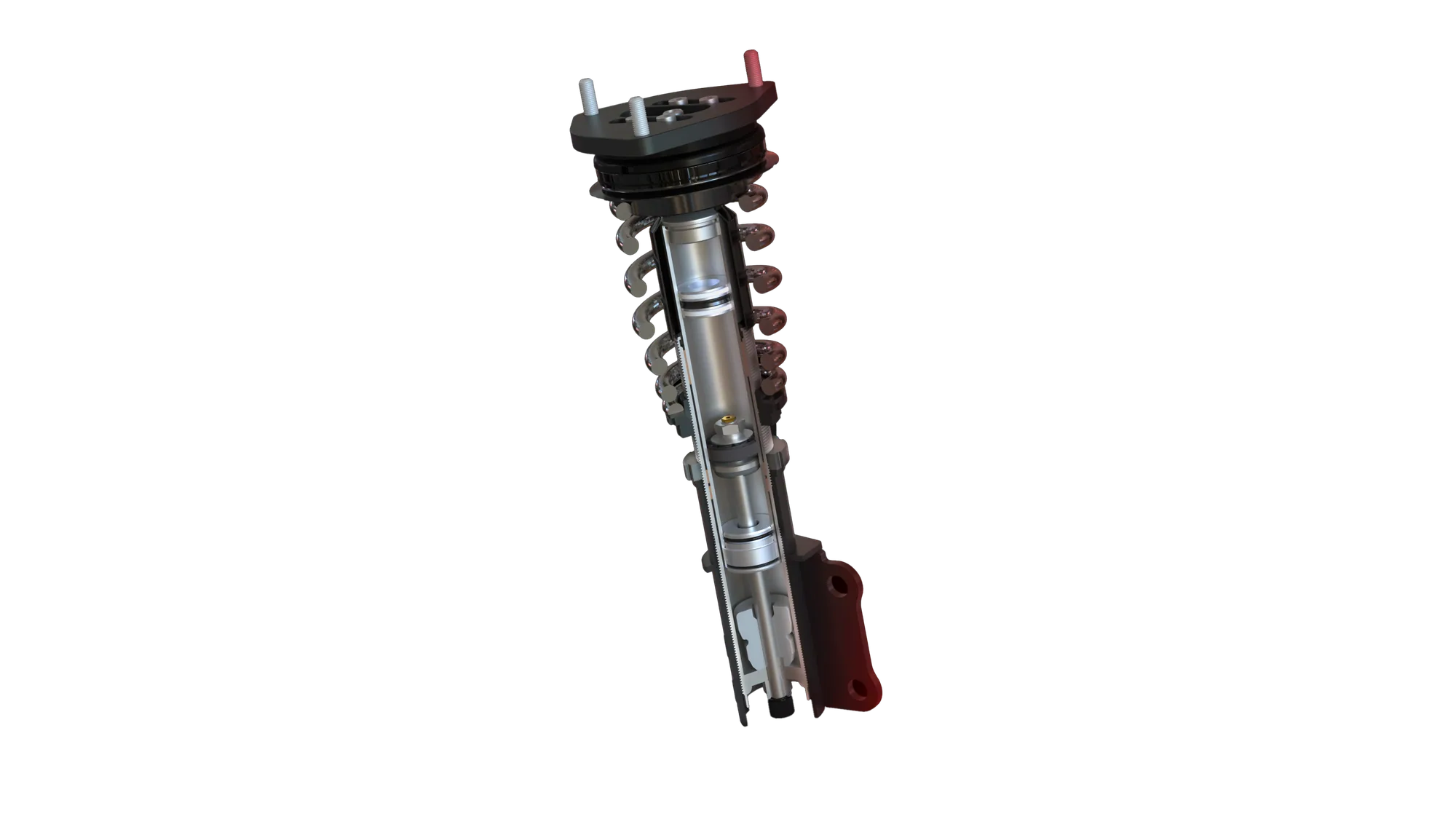
The problem: a strut is not just a damper
The MacPherson strut layout, used on the majority of production cars, gives the damper a second job. Beyond controlling wheel motion, it is a structural member of the suspension — it locates the wheel and holds alignment under load.
That means every cornering force, every mid-corner bump, every curb strike feeds a lateral bending load into the strut. In a conventional strut, significant lateral and bending loads are transmitted through the piston rod and its guide system — the slenderest part of the load path.
The consequences accumulate:
- Shaft deflection under high cornering load, which changes damping response exactly when you need it to be predictable
- Accelerated seal and guide bushing wear
- Progressive loss of consistency over the life of the damper
The inverted solution
An inverted monotube flips the assembly. The large-diameter damper body occupies the load-bearing upper position, and the piston rod is protected below.
Because bending stiffness scales sharply with diameter, placing the larger-diameter damper body within the primary load path — and running a wider span between guides — provides greater lateral rigidity and improved resistance to bending under high cornering loads, for the same package size.
This structural advantage is particularly relevant in MacPherson-strut applications, where the damper assembly is also part of the suspension's structural load path and must withstand significant lateral and bending loads.
What this buys:
- Resistance to lateral deflection — the strut holds its geometry under load
- Structural rigidity — less shaft bending during high-load cornering
- Consistency over time — reduced wear at the seal and guide
- Repeatable damping — the damper behaves the same on lap 20 as on lap 1
This construction costs more to manufacture. It is worth it in motorsport and high-load street applications, where durability and consistency are the whole point.
Lateral load response in MacPherson strut suspension
Left: inverted monotube — the large body takes the load and holds geometry. Right: conventional — the piston rod bends under the same cornering force.